A car battery and a UPS battery might look similar from the outside, but they're built to do very different jobs. A car battery delivers a short, powerful burst to start an engine and then gets recharged almost immediately. A UPS or solar battery has to do the opposite — deliver a slow, steady trickle of power for hours, sometimes with the sun or grid not topping it up for a while. Use the wrong type and you'll get poor runtime, a short lifespan, or both.
UPS Batteries vs. Starter Battery: What's the Difference
A starter (automotive) battery is built with many thin plates to deliver a big current spike for a few seconds. A UPS Batteries battery uses fewer, thicker plates designed to be drained down and recharged repeatedly without damage — exactly what a home UPS or solar system asks of it every single day.
- Starter batteries degrade quickly if repeatedly drained below 50% — UPS Batteries batteries are built to handle it.
- UPS Batteries batteries sustain a steady voltage over hours, where starter batteries sag under prolonged load.
- Using a starter battery for daily UPS cycling typically cuts its working life dramatically compared to a proper UPS Batteries unit.
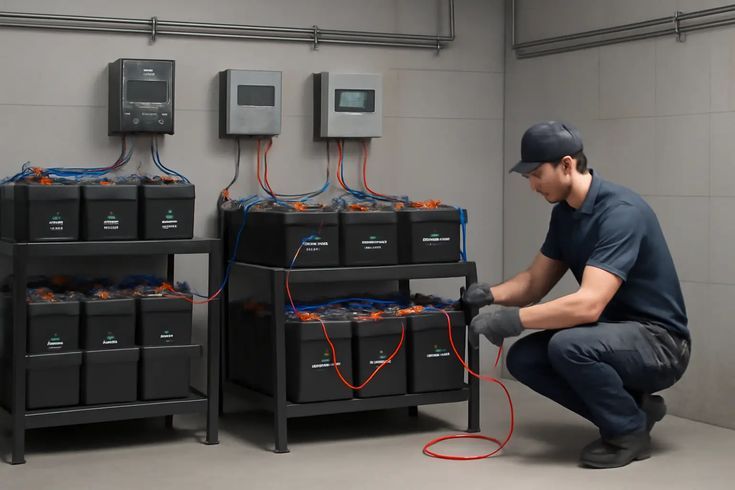
How to Size Your Battery Bank for Your Inverter's Load
Sizing a battery bank comes down to three numbers: your daily load (in watts), how many hours of backup you want, and your inverter's voltage. Multiply your appliances' wattage by the hours you need them running, divide by your system voltage, and you get the amp-hours (Ah) your bank needs to supply.
Daily Load
Add up the wattage of everything you want to run — lights, fans, router, fridge — during an outage.
Backup Hours
Decide how many hours of runtime you need per outage — this directly scales your required Ah.
System Voltage
Most home inverters run at 12V, 24V, or 48V — this decides how batteries are wired together.

Series vs. Parallel: How Battery Bank Wiring Works
Once you know your Ah requirement, how you wire multiple batteries together matters just as much as which battery you buy:
- Series wiring — connects batteries positive-to-negative, which adds their voltages together while keeping the same Ah. Use this to reach your inverter's required voltage (e.g. two 12V batteries in series for a 24V system).
- Parallel wiring — connects batteries positive-to-positive and negative-to-negative, which keeps the voltage the same but adds the Ah capacities together. Use this to extend runtime at the voltage you already have.
- Series-parallel — combines both, common in larger solar banks that need both a specific voltage and a large capacity.
Which Brand Fits a UPS or Solar Setup Best
Among the brands we stock, Eurobat, Alaska, Phoenix, Daewoo, Exide, AGS and Osaka are best suited to UPS Batteries UPS and solar use — While Eurobat excels with high-capacity, sealed UPS designs (up to 150Ah) and Osaka stands out for thick-plate durability under frequent deep discharges, options like Alaska, Phoenix, Daewoo, Exide, and AGS complete our versatile lineup to match any power requirement or budget. See our full brand comparison for more on how each brand is built.
Maintenance Tips for UPS and Solar Batteries
- Avoid draining below 50% (DOD) capacity regularly — it shortens the working life of most UPS Batteries batteries.
- For lead Acid Batteries, deep cycle or tubular Batteries the capacity of drainage is 60%to 70%.
- Keep the battery bank in a cool, ventilated space — heat wears down UPS Batteries batteries the same way it does car batteries.
- Check terminal connections and cable tightness every few months — a loose connection in a bank reduces total output.
- Get the bank load-tested each season change to catch a weakening unit before the whole bank underperforms.
Frequently Asked Questions
Can I use a car battery for my home UPS?
You can, but it's not ideal — car batteries are built for a short burst of high current, not the slow, sustained discharge a UPS or solar system needs. A UPS Batteries battery lasts much longer under that kind of use.
How many batteries do I need for my solar system?
It depends on your daily load in watt-hours, your inverter's voltage, and how many hours of backup you want. Tell us your appliances and hours needed and we can size a bank for you.
Should I wire my battery bank in series or parallel?
Series wiring increases voltage while parallel wiring increases capacity (Ah) at the same voltage — which one you need depends on your inverter's voltage requirement and how much runtime you want.
Ready to set up backup power at home?
Tell us your inverter's voltage and daily load, and we'll recommend the right battery, size, and wiring layout — plus doorstep delivery and setup help.